


For UK HNWIs choosing a relocation destination after the April 2025 non-dom abolition, Cyprus, Dubai and Italy each offer materially different propositions. Cyprus suits EU residency with tax efficiency through Cyprus relocation packages, a 17-year non-dom regime, the simplified 60-day tax residency rule, and the 15% corporate rate. Dubai suits zero personal tax for individuals willing to leave the EU entirely — 0% personal tax, 9% corporate tax, no EU access. Italy now requires €300,000 per year as a flat tax for new residents from 1 January 2026 (up from €200,000) — suitable only for very-high-income individuals with substantial foreign income. For the majority of UK relocators, Cyprus is the most economically credible choice.
The three propositions at a glance
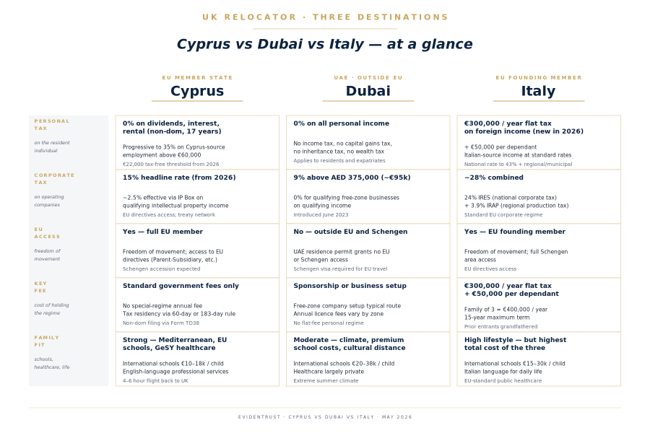
Each destination targets a different relocator profile. The headline differences:
Cyprus offers a 17-year non-dom regime exempting worldwide dividends, interest and rental income from Special Defence Contribution; tax residency in 60 days; a 15% corporate tax rate (with IP Box at ~2.5% effective); EU membership; English-language professional services; and personal income tax progressive up to 35% above €60,000 (with €22,000 tax-free threshold from 2026).
Dubai offers no personal income tax; a 9% corporate tax rate on profits above AED 375,000 (~€95,000), with qualifying free zone businesses at 0%; no inheritance tax; no capital gains tax; and full work rights for residence permit holders. It is not in the EU, and a Dubai residence permit does not grant Schengen or EU access.
Italy offers a flat tax of €300,000 per year on all foreign income for new residents, for up to 15 years — raised from €200,000 effective 1 January 2026 under the 2026 Budget Law. Italian-source income is taxed at standard Italian rates. Per-dependant surcharge is €50,000. Suitable only for individuals with foreign income well above €1 million per year.
Cyprus — the EU non-dom playbook
Cyprus is the most popular EU destination for post-2025 UK relocators for four reasons.
First, the Cyprus non-domicile regime exempts worldwide dividends, interest and rental income from SDC for 17 years from the date the individual becomes a Cyprus tax resident. This is the longest such exemption window remaining in the EU. The base test is the Cyprus 60-day or 183-day rule; the certificate is filed via Form TD38.
Second, the simplified 60-day tax residency rule (effective 1 January 2026) means an individual can become a Cyprus tax resident with sixty days’ presence and business activity in Cyprus, even where another country also claims them as a resident. Dual residency is resolved under treaty tie-breaker rules.
Third, Cyprus operates in English at a professional services level and is in the EU. School-age children have access to IB and British-curriculum international schools at materially lower fees than UK equivalents. Family permits, banking, and day-to-day life are EU-standard.
Fourth, the Cyprus corporate tax rate at 15% (with IP Box at ~2.5% effective on qualifying IP income) makes Cyprus structurally competitive for consultants, founders and entrepreneurs running businesses through a Cyprus Ltd. The Cyprus tax framework is unusually stable — the 2026 reform is the first substantive corporate-regime overhaul since 2002.
Dubai — zero tax, no EU
Dubai (and the wider UAE) offers an absolute proposition: zero personal income tax. There is no income tax, no capital gains tax, no inheritance tax, and no wealth tax on individuals. Companies pay 9% corporate tax on profits above AED 375,000, with qualifying free zone businesses paying 0% on qualifying income.
The trade-offs are material. Dubai is not in the EU. A UAE residence permit does not grant Schengen or EU access, and travel to Europe requires either a Schengen visa or a separate EU residence. For families, schooling is provided by an extensive private sector at materially higher fees than Cyprus equivalents (typically AED 80,000–150,000 per year, around €20,000–€38,000). Healthcare is largely private, with mandatory insurance providing reasonable cover.
Practical considerations include climate (extreme summer heat from June to September with daytime temperatures above 40°C), regional geopolitics, and the cultural distance for UK families. Dubai works exceptionally well for some UK relocators and not at all for others — the cultural fit is the most variable factor.
Dubai suits: individuals or couples with very high investment income; entrepreneurs running businesses that benefit from Middle East / Asia connectivity; UK relocators willing to leave the EU entirely; those for whom the climate and lifestyle work.
Dubai does not suit: families with school-age children who want a European education context; relocators who want ongoing EU access; relocators sensitive to regional geopolitical risk; relocators whose business genuinely benefits from EU directives and treaty access.
Italy — the €300,000 flat-tax regime (updated 2026)
Italy’s flat-tax regime for new residents (“regime dei nuovi residenti”) was originally introduced in 2017 at €100,000 per year. The fee was doubled to €200,000 in 2024 for new entrants. Under the 2026 Italian Budget Law, the fee was doubled again to €300,000 per year — effective for individuals who become Italian tax residents from 1 January 2026 onwards. The per-dependent surcharge was also doubled, from €25,000 to €50,000.
Existing electors are grandfathered. Individuals who entered the regime before 1 January 2026 continue to pay the rate applicable at the time of their entry (€100,000 or €200,000) for the remainder of their 15-year term. New entrants from 2026 onwards pay €300,000.
The regime taxes all foreign income at the €300,000 flat rate regardless of amount, and exempts wealth, inheritance and offshore-asset reporting. Italian-source income is taxed at standard Italian rates (up to 43% national plus regional and municipal additions). The regime runs for a maximum of 15 years.
The economics work for individuals with foreign income well above €1 million per year, because the flat €300,000 fee is a smaller proportion of total foreign income at that scale. Below €1 million of foreign income, the regime is rarely the right answer compared to alternatives — the maths simply does not work.
Italy suits: ultra-high-net-worth individuals with €2 million+ of foreign investment income; relocators valuing Italian lifestyle and culture; HNWIs willing to pay a premium for a Western European base with the security and infrastructure that implies. Italy does not suit: relocators below ~€1 million of foreign income; relocators with family situations that require multiple dependents (the €50,000 per dependant surcharge stacks); relocators sensitive to the cost itself.
Side-by-side comparison
The headline comparison for a UK-origin relocator with €300,000 of foreign investment income, no significant Italian-source income, and a family of three (one principal, one spouse, one dependent child):
Cyprus: zero SDC on dividends/interest/rental under the non-dom regime; personal income tax progressive up to 35% on Cyprus-source earnings above €60,000; family residence permits available; international schools at €10–18k per child; total annual living cost (excluding tax) for a family of three roughly €70,000–€120,000 depending on lifestyle.
Dubai: zero personal tax on all income; no special regime fee; school costs typically €20,000–€38,000 per child; total annual living cost for a family of three roughly €120,000–€220,000 depending on lifestyle and emirate of residence.
Italy: €300,000 + €50,000 (spouse) + €50,000 (child) = €400,000 flat tax per year; school costs €15,000–€30,000 per child at international schools; total annual living cost for a family of three (excluding the flat tax) roughly €100,000–€200,000.
On these numbers, Cyprus is materially cheaper than Dubai or Italy. The Italian regime makes economic sense only at substantially higher foreign-income levels — typically €2 million+ — at which point the flat fee becomes a smaller proportion of the total.
Three personas — which jurisdiction wins
Persona 1 — UK Ltd consultant earning £250k–£500k
Cyprus wins. For many consultants, Cyprus Ltd setup for UK consultants combined with the 15% corporate tax rate and zero SDC on dividends under non-dom produces a materially better outcome than a UK Ltd at 25% + UK dividend tax. The IP Box adds further upside where the work is IP-based. Italy’s flat tax is not economic at this income level. Dubai is competitive but loses on EU access for ongoing European client work.
Persona 2 — Investment-income HNWI with €5m+ portfolio
Three credible options. Cyprus offers the cleanest answer if the individual’s lifestyle works on a Mediterranean island and they want EU access. Dubai offers the best pure-tax outcome (zero) for those willing to leave the EU. Italy works at this scale because €300,000 is a small proportion of total foreign income — and the lifestyle is the best of the three for those who value it. The choice usually turns on lifestyle and family preference, not economics.
Persona 3 — UK family with school-age children
Cyprus wins decisively. International schools at materially lower fees than UK equivalents, a Mediterranean climate, EU-standard family permits, English-language professional services, and a 4–6 hour flight back to UK family. Dubai is workable but expensive for schooling and culturally further from the UK. Italy is the most expensive option for a family by a wide margin.

Why most UK relocators choose Cyprus
In our practice, Cyprus is the destination chosen by roughly seven out of every ten UK relocators we work with. The reasons fall into four buckets. First, the economics: the Cyprus non-dom regime plus the 60-day rule plus the 15% corporate rate, produces a better outcome than alternatives for the majority of the income range we see. Second, EU access: many UK relocators continue to want European mobility for work, family or property reasons. Third, family fit: Cyprus suits families with school-age children much better than Dubai or Italy on a like-for-like cost basis. Fourth, language and professional services: Cyprus operates entirely in English at the professional services level, removing the friction that Italy and (more variably) Dubai introduce.
Cyprus is not the right answer for every UK relocator. Where Dubai or Italy is genuinely the better fit, we say so — and we make introductions to advisers in those jurisdictions. The point of this article is comparative honesty, not destination marketing.
Practical action points
- Quantify your foreign and source-country income before comparing — the Italy economics in particular depends critically on this number
- Identify your true non-negotiables — EU access, climate, schooling, language, and family proximity. Most relocators discover that two of the three destinations rule themselves out on a non-negotiable that they had not initially weighted heavily
- Model the after-tax outcome over a 5-year horizon, not just year one — the Italy 15-year term, the Cyprus 17-year non-dom clock, and the Dubai indefinite zero-tax position have very different long-term shapes
- A two-week exploratory trip to each shortlisted destination is the single most useful action a relocator can take before committing
- Get the adviser’s perspective in both the destination and the origin country. The UK tax-exit interaction differs materially across the three
Speak with Evidentrust
Evidentrust is a Cyprus-based, ICPAC-member firm that works with UK-origin individuals and families weighing relocation. We are open about Cyprus being the right answer for the majority of UK relocators — but where Dubai or Italy is the better fit for your situation, we will say so and help you get to the right adviser. Whether you’re considering Cyprus, Dubai or Italy, our Cyprus relocation packages provide a structured starting point for assessing your options. The first conversation is short, without obligation, and intended to help you decide whether Cyprus is the right fit for your situation.
Frequently asked questions
1. Which country is best for a UK non-dom in 2026?
For most UK relocators, Cyprus is the best answer because of the combination of EU access, the 17-year non-dom regime, English-language professional services, and lower family cost. Dubai is the best answer for individuals or couples with very high investment income, willing to leave the EU. Italy is the best answer for HNWIs with €2 million+ of foreign income who specifically want Italian lifestyle.
2. How much does Italy’s flat tax cost now?
€300,000 per year for new residents from 1 January 2026 (up from €200,000), plus €50,000 per dependant. The fee is grandfathered for individuals already in the regime at the previous rate (€100,000 or €200,000). The regime runs for a maximum of 15 years.
3. Is there income tax in Dubai?
No personal income tax in Dubai or the wider UAE. Companies pay 9% corporate tax on profits above AED 375,000, with qualifying free zone businesses at 0% on qualifying income. There is no inheritance tax, no capital gains tax, and no wealth tax on individuals.
4. Does Cyprus have a flat tax for new residents?
No. Cyprus does not have a flat-tax regime equivalent to Italy’s. Cyprus offers progressive personal income tax up to 35% on Cyprus-source income above €60,000, with a €22,000 tax-free threshold from 2026. Cyprus competitiveness comes from the non-domicile regime, which exempts worldwide dividends, interest and rental income from SDC for 17 years.
5. How long does the Cyprus non-dom regime last?
Seventeen years from the date the individual becomes a Cyprus tax resident, provided the individual was not a Cyprus tax resident for at least 17 of the prior 20 tax years and does not have a Cyprus domicile of origin.
6. Can I get a Dubai residence permit and visit Europe?
Yes, but with a Schengen visa rather than visa-free. A UAE residence permit does not grant Schengen or EU access. Many UK-origin Dubai residents apply for a Schengen visa or hold a separate EU residence (e.g., a Cyprus or Portugal residence card) for European travel.
7. How does the UK tax exit interact with each destination?
All three destinations are credible UK tax-exit jurisdictions. The UK statutory residence test is the same regardless of destination — what matters is genuinely ceasing UK residence under those rules. Following the UK non-dom abolition, the Temporary Repatriation Facility (12–15% on historic offshore funds, closing April 2028) is available regardless of destination. The interaction with each destination’s tax regime is the key planning question and should be modelled before committing.
8. Why does Cyprus win for families?
Three reasons. International school fees are materially lower than UK equivalents or Dubai (€10–18k vs £25–45k UK vs €20–38k Dubai). EU-standard family residence permits with clear paths to permanent residence. Cultural and linguistic proximity to the UK is higher than in Dubai or Italy for working-age UK families.