


For software companies, SaaS founders and businesses developing eligible intellectual property, the Cyprus IP Box can substantially reduce corporate income tax on qualifying profits.
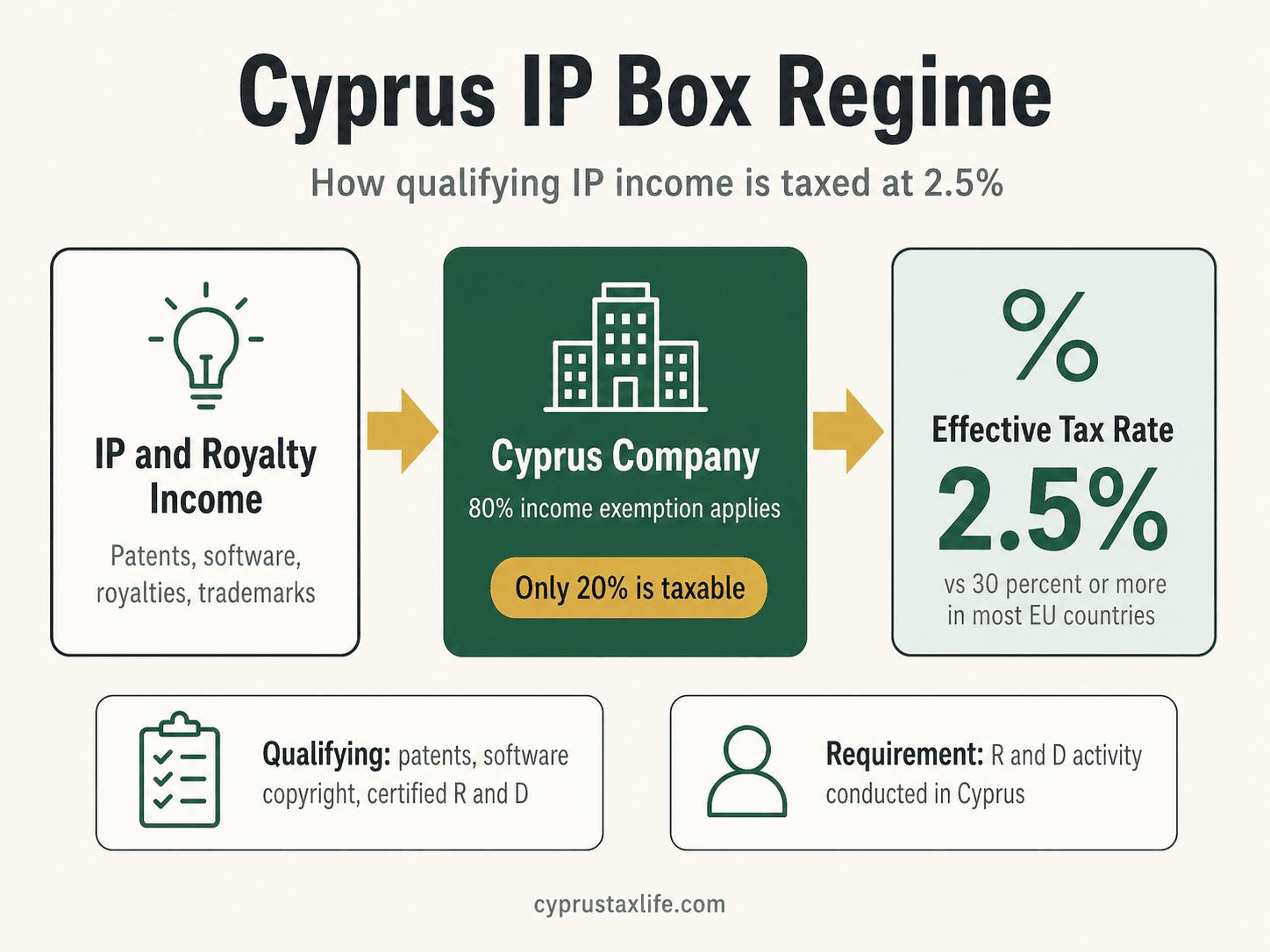
The regime provides an 80% deduction from qualifying profits, calculated using the modified nexus approach. With Cyprus’s standard corporate income tax rate at 15% from 1 January 2026, this can produce an effective corporate tax rate of 3% on the relevant net IP income where the nexus fraction is 100%. (gov.cy)
However, owning software or incorporating a Cyprus company does not automatically secure the full benefit. The outcome depends on the intellectual property, the company’s rights over it, its research and development expenditure, and the income attributable to the qualifying asset.
This guide explains the rules and the practical issues founders should address before relying on the headline rate.
What Is the Cyprus IP Box Regime?
The Cyprus IP Box operates under section 9(1)(k) of the Income Tax Law, Law 118(I)/2002, together with the Income Tax (Intangible Assets) Regulations 2016, KDP 336/2016.
It allows taxpayers to deduct 80% of their qualifying profits when calculating taxable income. Those qualifying profits are determined after applying the nexus calculation—not simply by taking all the profits of a technology business.
What Is the Effective Tax Rate in 2026?
Where the nexus fraction is 100%, the calculation is:
| Illustrative calculation | Amount |
| Net income from qualifying IP | €1,000 |
| Qualifying profits after applying a 100% nexus fraction | €1,000 |
| IP Box deduction: 80% × €1,000 | (€800) |
| Remaining taxable income | €200 |
| Corporate income tax: 15% × €200 | €30 |
| Effective corporate tax rate on the net IP income | 3% |
The equivalent full-benefit rate before 2026 was 2.5%, when the standard corporate income tax rate was 12.5%.
The 3% figure is not a tax rate on turnover or necessarily on all company profits. A lower nexus fraction increases the effective rate on the relevant net IP income. The illustrations also exclude other tax adjustments, credits and any applicable Pillar Two top-up tax.
What Qualifies Under the Cyprus IP Box?
Qualifying Assets
Broadly, qualifying assets must arise from research and development and be acquired, developed or exploited in the course of carrying on a business. The rules recognise economic ownership, so registration in the claimant company’s name is not a universal prerequisite.
The qualifying categories include:
- Copyrighted computer software, potentially including proprietary applications and SaaS platforms.
- Other specified legally protected assets, including utility models, rights protecting plants and genetic material, orphan-drug designations and extensions of patent protection.
There is also a category for legally protected, non-obvious, useful and novel IP, requiring certification by a competent Cyprus or foreign authority. For this category, the claimant’s annual gross income from all intangible assets must not exceed €7.5 million and, where it belongs to a group, worldwide group turnover must not exceed €50 million. Both limits use five-year averages.
These are not general turnover limits for copyrighted software or patents.
What Does Not Qualify?
Trademarks, brand names, trade names, image rights and other marketing-related intellectual property do not qualify. A valuable brand or customer-facing identity should not be confused with eligible technical IP.
For software businesses, the key is to identify the qualifying software rights separately from any brand or other non-qualifying assets.
Qualifying Income
Income potentially falling within the regime includes royalties, software licence fees and embedded IP income attributable to qualifying IP within the price of products or services. (gov.cy)
Trading income from selling qualifying IP can also enter the calculation. However, gains of a capital nature are excluded from the IP Box income calculation. Genuine capital gains on disposals of qualifying IP are generally exempt from Cyprus income tax and require separate classification rather than automatically being taxed at 3%.
For a SaaS company, subscription revenue is not automatically wholly qualifying. The return attributable to eligible software must be identified using a supportable methodology, taking account of other products or services supplied where relevant. The IP component need not be separately invoiced, but its attribution must be substantiated.
The Nexus Approach: What This Means in Practice
The modified nexus approach connects the tax benefit to qualifying research and development expenditure.
It distinguishes between R&D undertaken by the claimant or outsourced to unrelated parties, and expenditure on acquiring IP or outsourcing R&D to related parties. The expenditure ratio is cumulative, rather than being based only on the current year’s costs.
Start With Net IP Income
The calculation begins with the relevant IP income after attributable expenses, including applicable capital allowances. The deduction is therefore not calculated directly on gross revenue.
Eligible capital expenditure on acquiring or developing intangible assets is generally deductible over the asset’s useful economic life, subject to a maximum of 20 years. This annual tax deduction should not be confused with the expenditure used in the nexus calculation.
The Nexus Formula
For the relevant qualifying asset, let:
QE mean qualifying R&D expenditure; A mean IP acquisition expenditure; and R mean related-party outsourced R&D expenditure.
The calculation is:
Uplift = lower of (30% × QE) and (A + R)
Nexus fraction = (QE + uplift) ÷ (QE + A + R)
Qualifying profits = net IP income × nexus fraction
IP Box deduction = 80% × qualifying profits
Taxable IP income = net IP income − IP Box deduction.
Qualifying expenditure includes directly related R&D performed internally and R&D outsourced to unrelated contractors. Acquisition costs—whether paid to related or unrelated parties—and related-party outsourced R&D are excluded from QE, but enter the denominator and are relevant to the capped uplift.
The uplift is therefore not an automatic 30% addition in every case. Nor can the nexus fraction exceed 100%.
Worked Example: A Reduced Nexus Fraction
Assume a company has €100,000 of current-year net income from qualifying IP, after the relevant expenses.
Its cumulative expenditure comprises €100,000 of qualifying R&D and €100,000 of R&D outsourced to a related company, with no acquisition expenditure.
| Calculation | Amount |
| Net IP income | €100,000 |
| Cumulative qualifying R&D expenditure | €100,000 |
| Cumulative related-party outsourced R&D | €100,000 |
| Uplift: lower of €30,000 and €100,000 | €30,000 |
| Nexus fraction: €130,000 ÷ €200,000 | 65% |
| Qualifying profits: €100,000 × 65% | €65,000 |
| IP Box deduction: €65,000 × 80% | (€52,000) |
| Taxable IP income: €100,000 − €52,000 | €48,000 |
| Corporate income tax: €48,000 × 15% | €7,200 |
| Effective corporate tax rate on net IP income | 7.2% |
The expenditure figures above are cumulative nexus inputs. They are not deducted again from the stated net IP income.
The practical consequence is important: acquiring eligible IP does not itself generate qualifying R&D expenditure. Where QE is zero and the denominator is positive, the uplift and nexus fraction are also zero, producing no IP Box deduction.
What Happens If There Is a Loss?
Where the statutory qualifying-profits calculation produces a loss, only 20% of that relevant loss is available for offset and carry-forward under the applicable loss-relief provisions. This restriction should be considered when forecasting the tax position of an early-stage business.
Substance, Ownership and Documentation
The regime does not impose a fixed minimum number of Cyprus-based R&D employees. R&D outsourced to unrelated contractors, including contractors outside Cyprus, can qualify. Historical expenditure remains relevant under the cumulative nexus approach.
Nevertheless, the company’s actual activities, contractual rights and tax position must support the income attributed to it. Within a group, legal ownership alone does not establish entitlement to all the profits generated by IP. The functions performed, assets used and risks assumed by the relevant entities must be considered.
A practical review should therefore address who controls development, who bears the commercial risks, what the development and licensing agreements provide, and whether intercompany remuneration reflects the parties’ actual contributions.
The regulations require records of income and expenditure by intangible asset. Useful supporting evidence includes development agreements, project records, contractor invoices, payroll allocations and the basis used to identify the IP-related income.
Who Should Consider the Cyprus IP Box?
The regime is relevant to businesses whose income is attributable to qualifying software or other eligible IP, including SaaS providers, application developers and businesses exploiting patents.
For AI, fintech and other technology founders, the starting point should be the underlying rights and development activity—not the company’s industry label. International groups should also assess their ownership arrangements and transfer-pricing position before allocating IP income to Cyprus.
A useful initial assessment is to map the business’s IP assets, revenue streams and historical development expenditure before modelling the potential tax benefit.
Common Mistakes to Avoid
Confusing eligible assets with eligible profits. A software asset may qualify, but the available deduction still depends on the nexus calculation. Acquired IP does not automatically deliver the full benefit.
Treating the deduction as unsupported or automatic. The claim should be reflected in the tax computation and return and supported by appropriate records. An advance tax ruling is not a general statutory prerequisite for the deduction; the specific certification requirement for the residual IP category remains a separate matter.
Ownership paperwork alone does not determine the tax outcome. Contracts, actual conduct and the allocation of functions and risks must be considered together, particularly for group structures.
How Evidentrust Can Help
An IP Box assessment should establish which assets and income streams qualify, reconstruct the relevant R&D expenditure and calculate the available deduction.
The review should also address the company’s operating arrangements, supporting documentation and any issues requiring input from IP legal advisers.
At Evidentrust, we advise tech founders, software companies and international businesses on IP Box eligibility, structure and documentation, working alongside legal advisers where appropriate. Contact info@evidentrust.com to arrange a consultation.
Frequently Asked Questions
Does copyrighted software qualify for the Cyprus IP Box?
Yes. Copyrighted computer software is a qualifying asset category. Proprietary applications and SaaS platforms may fall within it, but the available deduction depends on the relevant rights, income and nexus calculation.
What is the effective tax rate under the Cyprus IP Box in 2026?
Where the nexus fraction is 100% and the full deduction is claimed, the corporate income tax calculation is 15% × 20% = 3% of the relevant net IP income. A reduced nexus fraction produces a higher effective rate, before considering other tax adjustments.
Do trademarks qualify?
No. Trademarks, brands and other marketing-related IP are excluded. They should not be included merely because the same business also owns qualifying software.
Does Pillar Two affect the Cyprus IP Box?
Potentially. Cyprus’s Pillar Two rules generally cover constituent entities of multinational groups and large-scale domestic groups with consolidated annual revenue of at least €750 million in at least two of the four preceding financial years, subject to statutory exclusions and special rules.
The test is at group level, not simply by reference to the Cyprus company’s turnover. An in-scope group may still claim the IP Box deduction, but a separate top-up tax can arise. Pillar Two uses a jurisdictional calculation under its own rules; it does not simply apply 15% separately to each IP income stream.
Can R&D carried out by an overseas contractor qualify?
Yes, where the contractor is unrelated, and the expenditure meets the qualifying R&D conditions. Related-party outsourced R&D is treated differently: it counts as overall expenditure and may be partly covered by the capped uplift, rather than qualifying for the IP Box.
Is the IP Box available to individuals as well as companies?
Potentially, yes. Eligible taxpayers can include qualifying Cyprus-resident individuals carrying on a business and relevant Cyprus-taxable permanent establishments, as well as companies. However, the 3% illustration concerns corporate income tax; individuals remain subject to the applicable personal income tax rules and rates.
This article provides general information and does not constitute tax, legal or professional advice. Eligibility and the resulting tax position depend on the particular facts and applicable legislation.