


Happy family carrying cardboard boxes from empty room. Two little daughters helping parents with relocation in new apartment or house. Mortgage, relocation and moving day concept
Relocating to Cyprus with a family typically takes four to six months end-to-end and involves four parallel workstreams that must be sequenced correctly—tax residency and immigration, schools and education, healthcare and insurance, and banking and money. Families considering Cyprus relocation packages should begin planning nine to twelve months before their intended move. The most successful family relocations begin nine to twelve months before the intended move, with school applications and an exploratory visit as the two earliest actions.
The 12-month family relocation timeline
Family relocations move more slowly than individual relocations because of school applications, residence permits for dependants, and the practical logistics of moving a household. The realistic timeline below assumes you begin actively planning 12 months before your target move date.
12–9 months before move
Decide on your preferred city and, if possible, arrange an exploratory visit before making any commitments. Initial conversations with a Cyprus tax and relocation adviser should confirm your eligibility for tax residency under the 60-day or 183-day rule and determine the most suitable residence permit route. At this stage, it is also worth assessing whether you may qualify for Cyprus non-domicile status, as this can significantly influence your long-term tax planning. Begin shortlisting schools early, as international schools often have waiting lists and applications typically open around nine months before the academic year begins.
9–6 months before move
Lock the school. Submit applications to your top one or two choices. Begin property search (rental for the first 12 months is the default; purchase later once you know the neighbourhood). Open initial bank conversations — Cyprus banking takes longer than UK banking, and starting the conversation early avoids a gap on arrival. Begin residence permit applications where possible.
6–3 months before move
Confirm school place and finalise property arrangement. Brief your existing UK or home-country accountant on the timing of your tax exit. Arrange shipping or storage for household contents. Make pet relocation arrangements (most UK pet relocations to Cyprus require 4–6 weeks lead time).
3–0 months before move
Finalise residence permits. Complete bank account set-up to the extent possible pre-arrival. Confirm utility arrangements at the new property. Coordinate the timing of school year start with the move date. Brief your accountant on the cessation of your existing tax residency.
Choosing where to live — the four cities
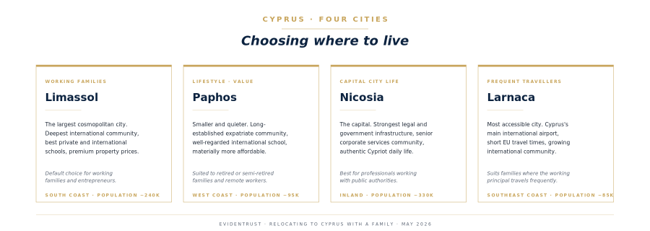
Cyprus has four cities and a number of well-developed towns. For most international families, the practical choice is between Limassol, Paphos, Nicosia and Larnaca. Each suits different family profiles.
Limassol
The largest cosmopolitan city, with the deepest international community, the best private and international schooling, and the most senior professional services sector. Limassol is the default choice for working families and entrepreneurs. Property prices and rental yields are the highest in Cyprus. Best for: families with working principals in financial services, technology, or international business; families wanting the broadest international school choice.
Paphos
Smaller, quieter, with a long-established international community and an attractive lifestyle profile. Paphos has a well-regarded international school and a small but functioning professional services community. Property is materially more affordable than Limassol. Best for: retired or semi-retired families; remote-working principals; families prioritising lifestyle and value over career proximity.
Nicosia
The capital. Strong legal and government infrastructure, the most senior corporate services community, and the right base for professionals whose work brings them into contact with Cyprus public authorities. Property is moderately priced. The international community is smaller and more professional. Best for: families where the working principal interacts regularly with regulators, courts or government; families seeking a more authentic Cypriot daily life.
Larnaca
The most accessible city — Cyprus’s main international airport is in Larnaca and travel times into the EU are short. The international community is smaller than Limassol but growing. Best for: families where the working principal travels frequently and wants airport proximity to dominate other decisions.
Schools — public, private bilingual, and international
Cyprus has three categories of school relevant to international families. The choice depends on the children’s ages, the family’s intended length of stay, and language considerations.
Public schools
Free, Greek-language, with English taught as a second language from age 9. Suitable for younger children (under 7) who can absorb Greek quickly, and for families intending to stay in Cyprus long-term. Less commonly the right choice for older children, shorter-term stays, or families wanting English-language continuity.
Private bilingual schools
Greek-and-English curriculum, with materially stronger English provision than public schools. Modestly priced (typically €5,000–€8,000 per year per child). Suitable for families looking for a Cypriot education with strong English continuity.
International schools
Several well-regarded international schools across Limassol, Paphos and Nicosia, teaching the International Baccalaureate (IB), British curriculum (IGCSE, A-level), or American curriculum. Fees range from €10,000 to €18,000 per year per child for the better-known schools — materially lower than equivalent UK private schools but a meaningful annual cost. Demand is high and waiting lists are common — apply at least nine months before intended start.
Healthcare — GeSY and private insurance
Cyprus operates GeSY, a national universal healthcare system funded by mandatory contributions from residents and employers. As Cyprus tax residents, the whole family is entitled to register for GeSY and to receive care under it. The quality of GeSY primary care and outpatient services is good; the system is included in your tax contributions.
Most international families also maintain private health insurance, primarily for faster access to consultants, private hospital care, and English-speaking provision. Premiums for a family of four typically range from €2,500 to €5,000 per year depending on cover scope — materially lower than equivalent UK private cover.
Banking and money
Cyprus banks have a well-developed AML diligence process. Account opening for a new family arrival typically takes two to six weeks for EU nationals and four to ten weeks for third-country nationals. Online challenger banks (Revolut, Wise) are widely used by families as a faster alternative for everyday transactions, particularly in the first few weeks before the Cyprus account is fully operational.
Practical sequencing tip: open the Cyprus bank conversation alongside the residence permit application, not after. The two run in parallel.
Residence permits for spouse and children
Family residence permits depend on the principal’s nationality and the type of permit they hold.
For EU-national families
EU-national spouses and children apply using the same Yellow Slip route as the principal (Form MEU1 or MEU1A). Non-EU spouses or children of an EU-national principal apply for a Residence Card using Form MEU2 (valid five years initially, then permanent residence after five years of continuous residence).
For UK or third-country national families
Spouses and dependent children apply as dependants of the principal under the same permit category. Many UK-origin family relocators are now exploring Cyprus following changes to the UK’s non-dom tax regime. For Pink Slip or Category F holders, dependants follow the principal’s permit and renewal cycle. The income thresholds for the principal are uplifted to account for dependants.
Practical action points
- Decide your target Cyprus city before applying to any school — the school choice is constrained by where you will live
- Begin school applications no later than 9 months before intended start
- Schedule at least one exploratory visit before committing to a city — most families fly to Cyprus twice before moving
- Open the bank conversation alongside the residence permit application, not after it
- Rent for the first 12 months — do not buy property until you have lived in the neighbourhood through a winter
- Brief your existing accountant on the timing of your tax residency cessation in your home country — the timing interacts with the Cyprus residency claim
- Plan the move to coincide with the start of the Cyprus school year (September), not mid-year
- Maintain private health insurance during the GeSY registration window — there can be a 2–4 week gap
What about pets?
Pets can be relocated to Cyprus. UK pets typically require a rabies-vaccinated EU pet passport equivalent, a microchip, and a 4–6 week paperwork lead time. Cats and dogs travel in the cabin or as cargo, depending on weight and airline. Allow more time than you think — pet logistics often slip later than other workstreams.

Portrait of girl standing near bus on a stop, waiting for her public transport, schecks schedule on smartphone application, holds mobile phone, wears warm clothes.
Speak with Evidentrust
Evidentrust is a Cyprus-based, ICPAC-member firm offering Cyprus relocation packages for individuals and families relocating to the island.
Learn more about our Tier 2 family concierge package and premium relocation services. The first conversation is short, without obligation, and intended to help you decide whether we are the right firm for your situation.
Frequently asked questions
How long does it take to relocate to Cyprus with a family?
End-to-end, four to six months from engagement to fully operational family life — though families typically begin the planning process 9–12 months before the intended move. The bottlenecks are school applications, residence permits, and banking, all of which run in parallel.
What is the best city in Cyprus to live with children?
There is no single best answer — it depends on the family. Limassol offers the broadest international community and school choice but is the most expensive. Paphos offers value and lifestyle. Nicosia offers a more authentic Cypriot life. Larnaca offers airport proximity. Most working families choose Limassol; most retired or semi-retired families choose Paphos.
Are international schools in Cyprus good?
Yes. Cyprus has a well-developed international school sector, particularly in Limassol, with established IB and British-curriculum schools. Standards are good, fees are materially lower than equivalent UK private schools (€10–18k vs £25–45k), but waiting lists are common — apply at least nine months in advance.
Can my non-EU spouse join me in Cyprus?
Yes. The route depends on your nationality. If you are EU, your non-EU spouse applies for a Residence Card under Form MEU2. If you are a third-country national, your spouse is included as a dependant on your permit application.
Do my children need to learn Greek?
Not if they attend an international school — the curriculum is in English (or American or French depending on school). If they attend a public school, yes — Greek is the primary language. Most international families choose either an international school or a private bilingual school for this reason.Is Cyprus safe for families?
Yes. Cyprus consistently ranks among the safest countries in Europe by violent crime rates, and the four main cities are widely considered safe to walk in at night. Crime exists, but at materially lower rates than larger European cities.