

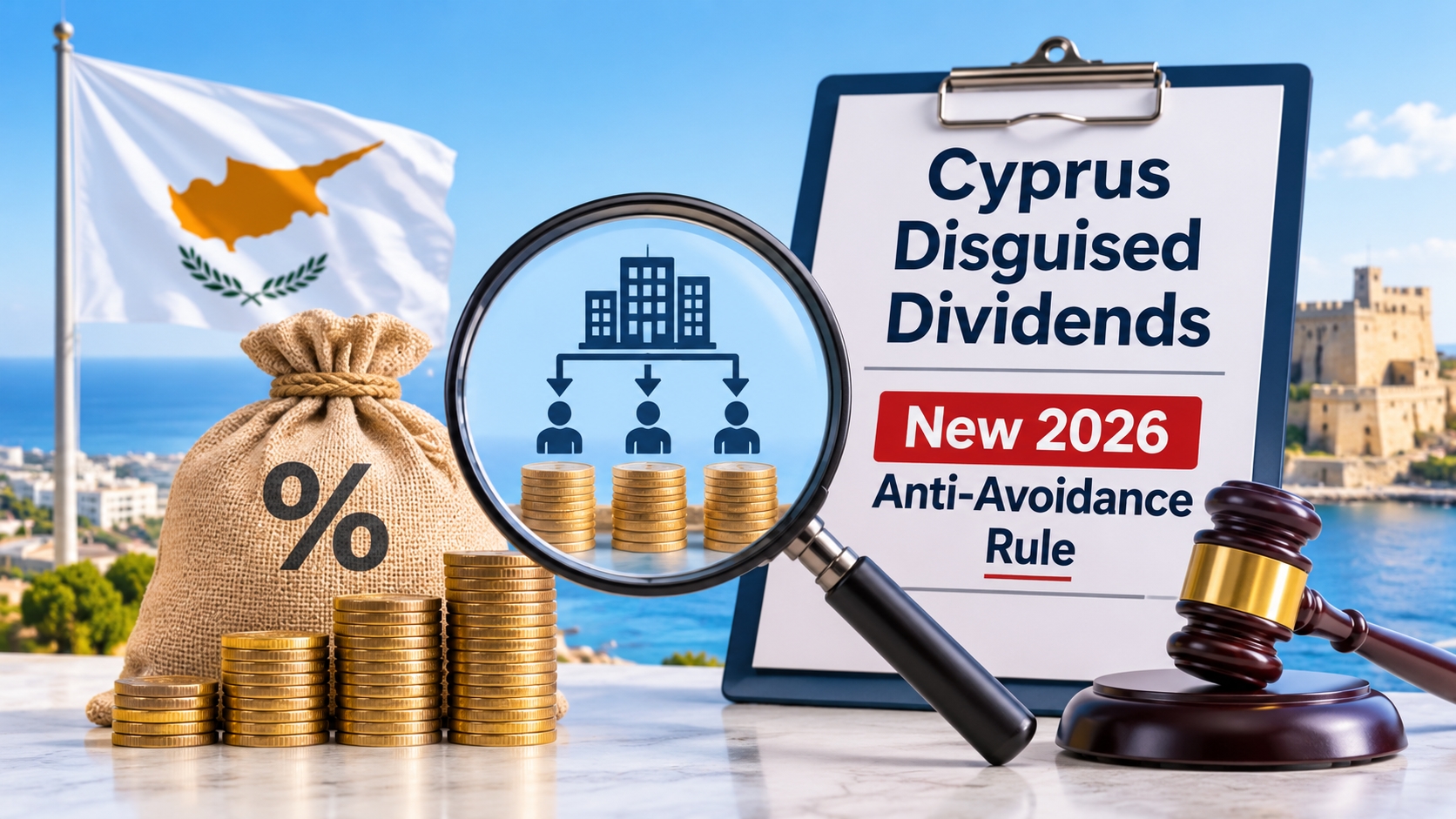
From 1 January 2026, Cyprus treats certain company benefits as disguised dividends. If a shareholder who is Cyprus tax resident and domiciled uses a company asset privately, or buys one below market value, the benefit is charged Special Contribution for Defence (SDC) at 10%. That is double the 5% rate on ordinary dividends from 2026 profits. The charge is a one-off amount based on the asset’s market value, and it applies to assets already in private use before 2026. This guide explains what triggers the rule, how the charge is measured and what owner-managed companies should review.
What is a disguised dividend under the 2026 reform?
A disguised dividend is a benefit that reaches a shareholder outside a formal dividend. Instead of declaring and paying a dividend, the company lets the shareholder enjoy its assets or transfers them at an undervalue. The reform treats the value of that benefit as if it were a distribution.
The rule forms part of the wider tax reform approved by the House of Representatives on 22 December 2025 and published in the Official Gazette on 31 December 2025.
Who does the rule apply to?
The rule applies to Cyprus tax-resident and domiciled individuals who are direct or indirect shareholders of a Cyprus tax-resident company. Benefits provided to related individuals, such as family members, are also caught. Shareholders who are non-domiciled are outside its scope.
Because indirect shareholders are included, holding structures are within reach. A person who owns a company through one or more holding companies can still be the individual whose benefit is tested.
What triggers the 10% charge?
There are two situations.
Private use of company assets. The disguised dividend is the market value of the asset when the private use begins, multiplied by the initial percentage of private use. The percentage is 100% where the asset has no connection to the company’s business. If private use later increases, a further charge arises on the increase, measured at the market value at that time. A later fall in private use does not produce a refund.
The rule applies to all company assets in private use, including assets that were already in private use before 1 January 2026.
Assets sold below market value. The disguised dividend is the asset’s market value on the date of disposal minus the price the shareholder paid. Any amount already charged under the private use rule is deducted.
How is the charge calculated? Two illustrations
The figures below are illustrations only. They are not based on any real company and are not advice on any individual’s position.
Private use. A company owns a property worth €300,000 that has no business purpose, and a shareholder begins using it privately. The initial private use is 100%, so the disguised dividend is €300,000. At 10%, the one-off charge is €30,000. This assumes the shareholder is not an employee or director taxed on the benefit under the Income Tax Law’s benefit-in-kind rules. Where those rules apply, the disguised dividend charge does not.
Sale below market value. A company sells an asset with a market value of €200,000 to a shareholder for €150,000. The disguised dividend is the €50,000 difference. At 10%, the charge is €5,000.
What is excluded from the rule?
The rule does not apply:
- Where the asset was donated to the company by the shareholder or a related individual;
- Where the benefit-in-kind provisions of the Income Tax Law already apply, for example where the shareholder is also an employee or director and the benefit is taxed through payroll; or
- Where the distribution forms part of a share capital reduction, dissolution or liquidation.
Two further points matter. The Income Tax Law’s arm’s length principle does not apply once the disguised dividend rules are engaged. And SDC charged under these provisions cannot be refunded.
How does this sit alongside the other 2026 changes?
The rule arrives at the same time as several other changes to how owners take profit from companies.
|
Measure |
What the reform provides |
Period or timing |
|---|---|---|
| Ordinary dividends to individuals | SDC falls from 17% to 5% | Profits earned from 1 January 2026. Dividends from earlier profits stay at 17% if received by 31 December 2031 |
| Disguised dividends | 10% one-off charge on private use of assets and below-market sales | From 1 January 2026, including assets already in private use |
| Deemed dividend distribution | Abolished | Profits earned from 1 January 2026. For 2024 and 2025 profits, 70%, less dividends already paid out of those profits, is deemed distributed and taxed at 17% on 31 December 2026 and 31 December 2027 respectively |
| Receivables from shareholders or directors | 9% deemed benefit extended to indirect shareholders | Income Tax Law change |
The general anti-abuse rule under the Income Tax Law now covers individuals as well as companies, and a general anti-abuse rule has been introduced into the Special Contribution for Defence Law.
Our guide to the 2026 deemed dividend distribution rules sets out the transitional position in more detail.
What should owner-managed companies review?
The rule changes what deserves attention in the books. These are general points for review, not advice on a specific company.
- Which assets does the company own, and does any shareholder use them privately?
- Does any family member or other related person of a shareholder use a company asset?
- Is any private use already taxed as a benefit in kind through payroll?
- Has the company sold or transferred any asset to a shareholder, and was the price consistent with market value?
- Are valuations and the basis for them recorded when an asset changes hands or private use begins?
- Do balances owed by shareholders or directors, including indirect shareholders, attract the 9% deemed benefit?
- Do holding structures show clearly who ultimately uses each asset?
Good records make these questions easier to answer, particularly in holding structures where the asset may sit several layers away from the individual who uses it. Businesses managing complex ownership arrangements may also benefit from professional corporate services in Cyprus to support their company administration and ongoing compliance requirements.
How can a tax adviser help with the disguised dividend rule?
The rule turns on facts: who uses an asset, how much, and at what value. A tax adviser can test those facts against the legislation and the company’s records, and explain how the rule interacts with benefit-in-kind provisions and other 2026 changes. Professional Cyprus tax services can also help shareholders and businesses understand their tax obligations and review the potential impact of the new anti-avoidance rules.
We prepare the accounts and the tax analysis from the same records, which makes these questions quicker to answer. For related reading, see our breakdown of Cyprus company annual costs and our guide to statutory audit requirements.
Frequently asked questions
What rate applies to disguised dividends?
The rate is 10%. That is double the 5% rate on ordinary dividends from profits earned from 1 January 2026.
Is the 10% charged every year?
No. It is a one-off charge based on the asset's market value when private use begins. A further charge arises only if the percentage of private use increases.
Does the rule apply to assets already in private use before 2026?
Yes. The rule applies to all company assets in private use, including assets that were already in private use before 1 January 2026.
Does the rule apply to non-domiciled individuals?
No. Non-domiciled shareholders are outside the rule. It applies to Cyprus tax-resident and domiciled individuals.
Can the 10% charge be refunded?
No. SDC charged under the disguised dividend provisions cannot be refunded.
Is deemed dividend distribution still in force?
It has been abolished for profits earned from 1 January 2026. Transitional rules still apply to 2024 and 2025 profits: 70%, less dividends already paid out of those profits, is deemed distributed and taxed at 17%.
Speak to us about your company
If you would like to understand how the disguised dividend rule applies to your company, speak with experienced accountants in Cyprus and book a consultation with Evidentrust.
This content is for general information only and should not be treated as tax, legal or professional advice.
Source: Special Contribution for the Defence Law as amended by Law 245(I)/2025 (section 3A), published in the Official Gazette on 31 December 2025.